
Women's CCAP Completion Paths
Chesterfield Women's Community Corrections Alternative Program is a VADOC placement at 7000 Courthouse Road. It is not the Chesterfield County Jail, and its participants should not be described as ordinary county-jail inmates. The Chesterfield Sheriff does not control the CCAP release record. VADOC, the program, the supervising district when applicable, and the responsible court hold the records that explain the participant's status.
Completion is a transition point. It can lead to community supervision, another VADOC status, or final discharge when the controlling sentence and order support that result. A transfer also ends one placement without ending state custody. The correct question is therefore not just whether the person left the CCAP site. It is what VADOC status followed and which document authorized that change.
| CCAP event | What it means | Where to verify |
|---|---|---|
| Program completion | The assigned CCAP phase ended; another state status may follow. | Program record, VADOC locator, and court or supervision papers. |
| Community supervision | The person is outside the program site but remains under probation or parole rules. | VADOC locator, release conditions, and District 27 when assigned. |
| Transfer | The person moved to another VADOC placement or lawful custodian. | VADOC location record and receiving agency. |
| Final discharge | The applicable state custody or supervision term ended. | Final VADOC release or discharge artifact. |
A scheduled date does not settle which row applies. Use the final program or VADOC record and read the court order that defined the placement.
Search Women's CCAP Status
The VADOC Inmate and Supervisee Locator covers CCAP as well as VADOC institutions and probation or parole supervision through district offices. VADOC states that locator information updates daily and may be inaccurate or out of date. A participant who completes the residential phase may still appear because supervision continues. Someone who fully discharges may later disappear from the tool.
- Open the state locator. Accept the official notice and use the VADOC search, not Chesterfield's county-jail channels.
- Enter a supported query. Search with the first three letters of the first name and the complete last name, or use the seven-digit DOC ID.
- Compare the match. Use age, race, gender, location, and available identifiers to avoid selecting a common-name result.
- Read the status. Determine whether the result indicates CCAP, another VADOC placement, or community supervision.
- Confirm the transition. Contact the program or assigned district and obtain the existing completion, release, transfer, or supervision document.
No result is not proof of release. Try a stable DOC identifier, confirm spelling, and ask whether the person moved to another state placement. Court disposition and sentence records can explain the legal basis, but they do not replace VADOC's event record. The Chesterfield County release-record search separates local jail, VADOC, federal, and other custody paths.
Note: Women's CCAP completion can place a person in the community while state supervision remains active.
Women's CCAP Records Contact
Use the VADOC program contact for present placement questions and narrowly framed records routing. Identify the person, seven-digit DOC ID when known, and the relevant dates. Ask for the existing CCAP completion or movement record, the current VADOC status, and any releasable release or supervision document. Do not ask the Chesterfield Sheriff to create a state-program history.
Chesterfield Women's Community Corrections Alternative Program
7000 Courthouse Road
Chesterfield, VA 23832
Phone: 804-796-4242
For state supervision, VADOC District 27 serves Chesterfield County and Colonial Heights at 6910 Courthouse Road, Chesterfield, VA 23832, phone 804-796-4225. Its published intake periods are Monday through Friday, 9 to 11:30 a.m. and 1 to 3 p.m. Follow the person's actual release or supervision papers, since the assigned office and reporting duty control.
VADOC inmate-information requests go to the unit manager, superintendent, or probation and parole district chief maintaining the record. The general VADOC FOIA contact is FOIA@vadoc.virginia.gov, 804-963-2953, P.O. Box 26963, Richmond, VA 23261. Ask for a specific existing artifact and expect lawful withholding or redaction where an institutional or supervision exemption applies.
Women's CCAP State Program
Official material traces the Chesterfield site through several state corrections roles. It began as a male prerelease center in 1971, shifted to a women's detention and diversion role in 2002, and later became a CCAP operation. That history supports careful wording today. CCAP is a community-corrections alternative within VADOC, not a standard local jail and not, by its name alone, proof that every participant is fully discharged.
The current official placement and contact context appears in the VADOC facilities and offices directory. The manifest maps that source directly to Chesterfield Women's CCAP.
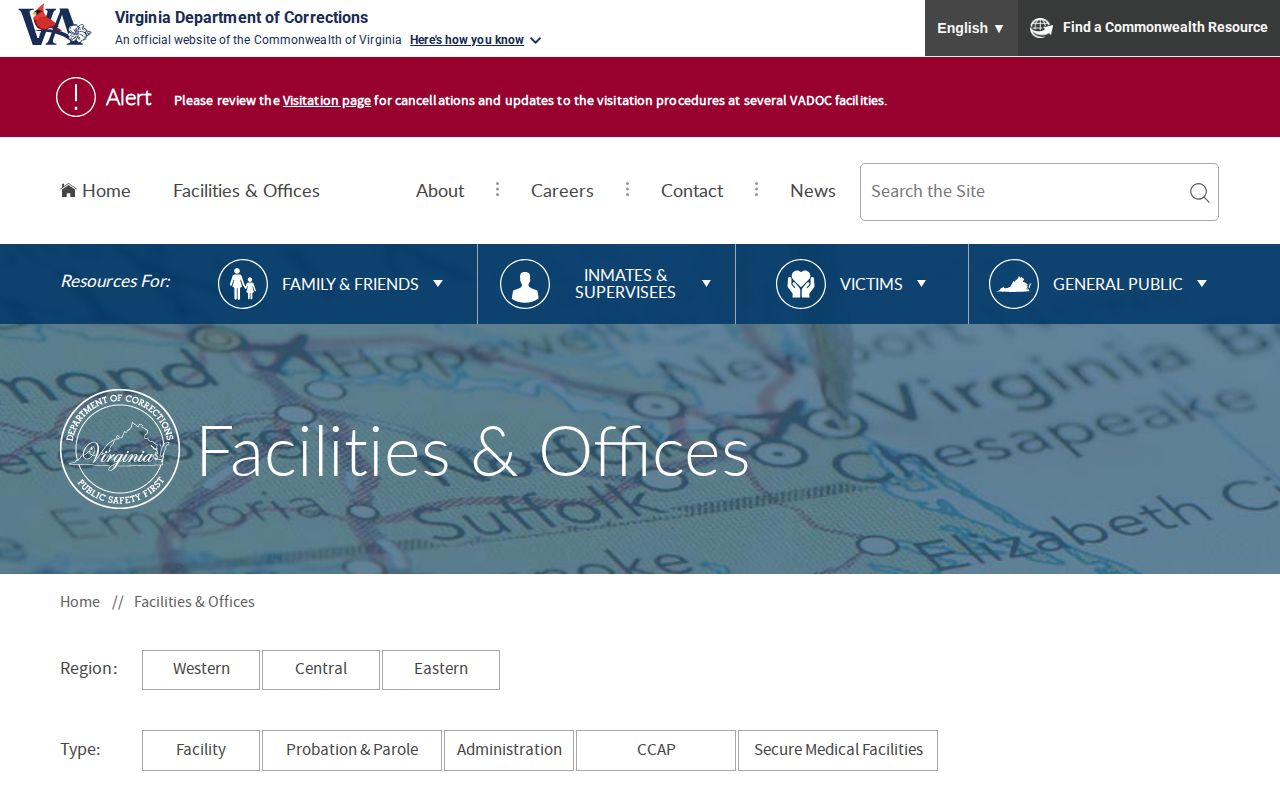
The directory confirms where the program belongs. A Chesterfield address does not move its records into the county Sheriff's release system.
Women's CCAP Release Records
“Release record” is not one universal form. For CCAP, ask for the existing record that names the program completion, transfer, release, or supervision transition. If probation or parole follows, the applicable Conditions of Probation or Conditions of Parole can identify reporting duties. A notification-of-release letter or Order of Release may apply to a VADOC release depending on the person's status.
The court record adds the legal framework. It may show the sentence, active and suspended portions, probation, and later docket activity. Yet it usually does not record the moment the program changed the participant's physical status. A Parole Board report, when parole is involved, records Board action rather than the completed exit. Pair the authority with VADOC's operational artifact.
- Completion
- The assigned program phase ended; the next status must still be identified.
- Probation
- Court-ordered supervision that can follow custody or begin without a prison term.
- Parole
- Board-authorized release into VADOC supervision for a legally eligible state prisoner.
- Discharge
- The end of the applicable custody or supervision obligation shown by the final agency record.
Virginia FOIA covers existing records subject to its procedures and exemptions. It does not require VADOC to answer a new calculation or create a custom status report. A narrow request for named documents is more useful than asking whether the person is simply “free.”
Women's CCAP Release Notices
Notification registration must match the custodian. Virginia VINE is a person-specific local custody search and notification system, but VADOC's notification page says its state-prison victim notification through NAAVI is a separate registration. Do not assume that a local jail VINE registration follows a person into CCAP or covers a later VADOC event.
VADOC distinguishes an “Advanced release” notice, which is an anticipated date and can change, from a “Release date” notice stating that the person is no longer in VADOC custody. That distinction matters for a CCAP participant. An anticipated date supports planning. It does not prove completion, identify the next supervision status, or rule out a transfer or hold.
If the locator shows community supervision after CCAP, contact the displayed or assigned district. Detailed supervision records may be protected, but the person should follow the reporting office and conditions stated in the signed papers.
Women's CCAP Release Dates
A VADOC release date is a calculation until the event occurs. Factors can include jail credit, sentence type, total sentence, earned-credit class, disciplinary infractions, other sentences, and later legal events. Virginia does not have one universal “85 percent” rule. The controlling offense, statutory version, credits earned and kept, and any other sentence or hold all affect the result.
CCAP adds another status question. A date can mark the end of the program phase while probation or parole continues. It can also precede movement to another VADOC placement. Use the locator date for planning, then obtain the final document and identify the next status. Do not apply Unit 13's facility logistics or Chesterfield Jail's bond timing to a CCAP transition unless VADOC confirms that rule for the event.
The Chesterfield projected release date resource explains VADOC's documented calculation factors and why the final state record remains necessary.
Women's CCAP Detainer Transfers
A detainer is a lawful basis for another authority to seek or continue custody. It can turn the end of a CCAP placement into a transfer rather than a community discharge. VADOC's movement or release record should identify the state event, while the receiving agency's system answers what happened next. Absence from the VADOC locator by itself does not settle that sequence.
Chesterfield has documented local transfers to Riverside or another authority, and the county says it cooperates with ICE when assistance is requested. That local history does not prove a detainer in a Women's CCAP case and does not establish an ICE detention contract. Use the ICE Online Detainee Locator only when an immigration handoff is plausible. Treat a no-result as inconclusive.
For another VADOC placement, recheck the state locator after its daily update. For federal custody, use the BOP Inmate Locator instead of VINELink. For a court-ordered state transition, read the signed order and the VADOC artifact together. Keep “left CCAP,” “released from VADOC custody,” and “off supervision” as three separate claims.
Note: Ending a Women's CCAP placement can begin another lawful status, so verify both the departure record and the receiving or supervising agency.